Special Collections
(760) 750-4312
archives@csusm.edu
Hours: by appointment
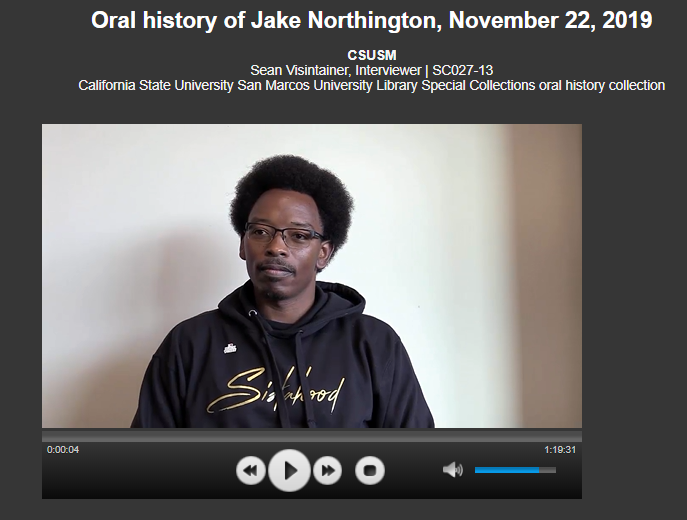
Oral histories are one-time, never-to-be repeated guided conversations with a narrator (interviewee) and interviewer with a specific line of inquiry, usually the narrator's participation (intended or not) in an event, movement, or profession. They can also be biographical in nature. Oral histories are rich primary sources that give first-hand accounts, with reflection, from the narrator.
CSUSM Special Collections also uses oral history as a teaching tool, with student-produced oral histories being created through internships, service learning commitments, and class embedations.
Our recorded audio or video interviews are published, along with written transcriptions, on Voices of North County, the University Library's oral history portal. Voices is a continuously growing archive of the library's oral histories of members of our North San Diego County region.
Each oral history also gets a finding aid entry, providing additional context to the interview, and linking the interviews to other resources in CSUSM's Special Collections and University Archives. Some oral histories may also be found in individual collections. See below for different ways to access our oral histories.
Oral History Collections and Finding Aids
- Voices of North County, CSUSM University Library's oral history portal
- CSUSM's oral history collection finding aid (Brewchive®, community/regional, and University Archives oral histories)
- Dan Rios papers finding aid (contains three interviews with Dan Rios)
- Green Tiger Press records finding aid (contains one interview with Green Tiger Press publisher
- CSUSM Veterans Voices finding aid (a CSUSM History department oral history initiative)
Oral Histories by Community
CSUSM's oral histories have been "tagged" when an interviewee identifies with specific communities. Tags can be related to race, ethnicity, gender, sexuality, profession, and more. To see oral histories related to a specific community, click the link below. Results show both the interview and the transcript. Transcripts are noted as such in the title.
- Activists and activism (related to interviews that are of activists or contain accounts of activism)
- Art and artists (related to individuals that create works of visual or performance art or are involved with the arts in a non-artist capacity, usually professional in nature)
- Asian Pacific Islander Desi American experience (related to interviewees that identify as culturally or ancestrally from East, Southeast, South Asia, and/or the Pacific islands, whether they are American-born or born abroad)
- Black experience (related to interviewees that identify as Black American, African American, or Black African)
- Brewchive® (related to interviewees that identify as part of San Diego County's craft brewing industry and scene)
- Community history (related broadly to members of our North San Diego County regional community)
- CSUSM history (related to interviewees with members of Cal State San Marcos's students, alumni, staff, faculty, and administration)
- Immigrant experience (related to interviewees that were born abroad and emigrated to the United States of America)
- Jewish experience (related to interviewees that identify as religiously or culturally Jewish)
- Latine experience (related to interviewees that identify as Chicano/a/x, Latino/a/e, Hispanic, Latin American, Mexican American, and/or identify as culturally or ancestrally from Latin America)
- LGBTQIA+ experience (related to interviewees that identify as Lesbian, Gay, Bisexual, Transgender, Queer, Intersex, and/or Asexual)
- Native American experience (related to interviewees that identify as indigenous to North, Central, and South America)
- Politics and governance (related to interviewees who have worked in governmental or nongovernmental capacities related to public administration and public service)
- Veteran experience (related to interviewees who have served in the armed services, especially the military of the United States)
- Women's experience (related to interviewees that identify as women)
Oral Histories by Project
Many of the oral history interviews found on Voices of North County have been made possible by the Ellie Johns Fund stewarded by the Library Guild of Rancho Santa Fe, which has provided funding towards internships and student workers to conduct and process oral histories, giving these CSUSM students real-world experience working in public history. Learn more about Ellie Johns here.
Additionally, the University Library's Special Collections department has collaborated with numerous partners to create and/or publish oral histories. Partnerships are listed below. Once a tag is clicked on, results can be sorted by title, creator, or date added, as shown in the screenshot below. Results show both the interview and the transcript. Transcripts are noted as such in the title.
- Black Student Center Oral History Project: partnering with CSUSM's Black Student Center, Special Collections students conducted interviews of eleven individuals integral to the student-led effort to advocate for and implement the university's Black Student Center. A companion digital project, Black Journey, was created which developed the framework for future projects and this website. The BSC's oral histories are in the process of being migrated over to Voices and will all be available shortly. These oral histories were funded thanks to the Instructionally Related Activities Fund.
- Children of Refugees is an ongoing project focused on the narratives of the Vietnamese diaspora born to parents who fled Vietnam in the years following the war. For more information, please see the project site.
- Cross-Cultural Center Oral History Project: partnering with CSUSM's oldest identity-focused student center for their 20th anniversary, Special Collections students conducted interviews of twelve individuals that detailed the founding, history, and impact of the CCC. A companion exhibition, Critical Conversations, was created. These oral histories were funded thanks to the Instructionally Related Activities Fund.
- CSUSM Veterans Voices: Originally called the War At Home and Abroad (WAHA) project, this project was conducted by the California State University San Marcos History Department and CSUSM Student Veterans Center (now the Epstein Family Veterans Center) from 2012-2013. Veterans Voices documents, preserves, and make accessible the experiences of CSUSM's student veterans related to the Gulf wars and Afghani War. Seven interviews were recorded as part of the project. For more information, please contact CSUSM's History Department at history@csusm.edu.
- History Department Internships: CSUSM's History Department and Special Collections partner on a yearly, for-credit, paid internship where History graduate students learn the methodology of oral history, conduct community interviews, and process them for Voices of North County.
- North County Oral History Initiative: Partnering with the San Marcos Historical Society, Special Collections and the SMHS conducted a workshop where volunteers were trained in oral history. Volunteers then used their knowledge to create oral histories of members of the regional community. The workshop was funded by a CSUSM institutional grant from Community Engaged Scholarship, and the oral histories resulting from this initiative are currently undergoing processing.
- Prugraman Sinipok is an adult Chamoru language immersion program that provides tools, instruction and resources to empower participants to give life to our heritage language. The program provides participants with the space, time, and intentional care needed to create community among like-minded learners, and to embrace their roles in the revitalization of the Chamoru language. In the summer of 2024, Sinipok was held at CSU San Marcos, where it was co-sponsored by the U-ACT grant. These oral history interviews came about as the result of this partnership.
- San Diego Veterans History Initiative: This project preserves and shares the lived experiences of military veterans across San Diego County through oral histories and transcripts. The project honors service, safeguards legacy, and creates lasting educational resources for future generations.